
How to prepare for your theory test: a two-week study plan
Fourteen days, split into topic learning, timed mock tests and a mistakes review, planned around the exact pass mark of the exam you are taking.
Read articleMock tests, road rules and formats follow it.
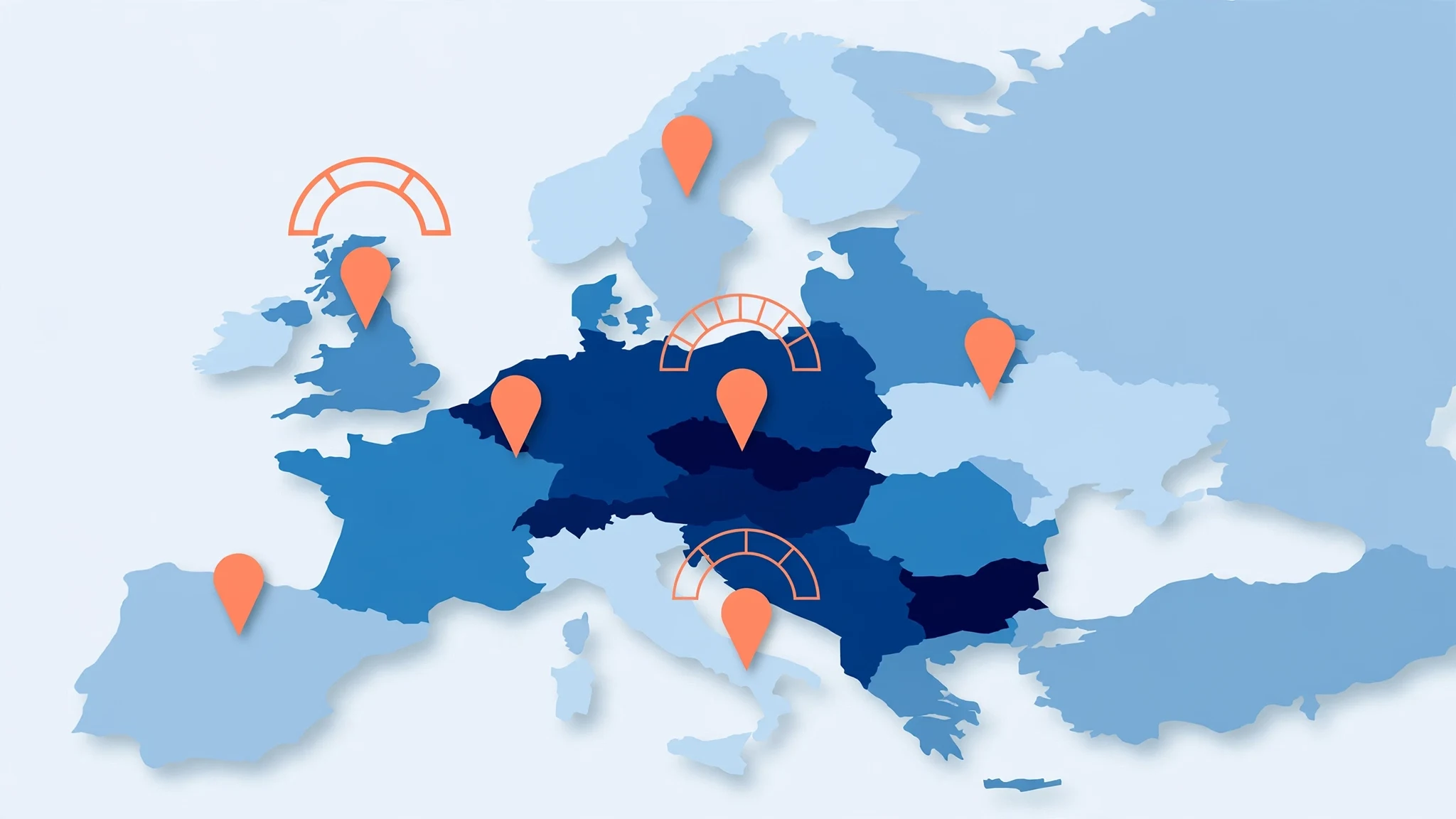
There is no European pass mark for the driving theory test. Each country sets its own format and its own line between pass and fail, and the lines are drawn in different units: correct answers in Portugal and France, an error limit in Italy and Spain, error points in Germany, weighted points in Poland, and two separate pass marks in the United Kingdom. This comparison puts the theory test pass marks of all seven countries on this site side by side, using category B, the car licence, unless stated otherwise.
| Country | Category B format | Pass mark | Scoring unit |
|---|---|---|---|
| Portugal | 30 questions | 27 of 30 | Correct answers |
| Germany | 30 questions | At most 10 error points | Error points, 2 to 5 per question |
| Poland | 32 questions | 68 of 74 points | Weighted points, 3, 2 or 1 per question |
| Italy | 30 true or false statements | At most 3 errors | Error limit |
| United Kingdom | 50 questions, plus 14 hazard clips | 43 of 50, and 44 of 75 | Two separate pass marks |
| Spain | 30 questions | At most 3 errors | Error limit |
| France | 40 questions | 35 of 40 | Correct answers |
Read the table as seven different answers to the same question: how much can you get wrong and still be trusted to know the rules? The sections below take each system in turn, because the headline number hides the part that actually matters for preparation, which is how the scoring behaves while you are answering.
Three of the seven countries demand the same effective standard, nine answers in ten right, but they reach it by different routes. Portugal is the most direct: the IMT exam for category B has 30 questions and you need 27 correct, so a fourth wrong answer fails the test. The Portugal hub shows the same strictness across the other categories.
Italy and Spain both express the standard as an error limit instead: at most 3 errors in 30 questions, which also means 27 correct. The similarity ends there. Italy’s exam is built from true or false statements drawn from the ministerial lists, so every question is a judgement on a single claim, and a candidate who is unsure still faces a coin flip rather than a choice among distractors. Spain’s DGT exam uses multiple choice questions with three options. Same arithmetic, different skill: Italy punishes shaky knowledge of specific rules, Spain punishes confusion between similar rules. The country pages for Italy and Spain explain each format in full.
France sets the longest standard exam of the group and the most forgiving error allowance in absolute terms: 40 questions, 35 correct answers required, so five errors still pass. In percentage terms that is 87.5 percent, just below the 90 percent group. Two features of the French exam matter for preparation. The first is length: sustaining accuracy across 40 questions is its own test of concentration. The second is that some questions have more than one correct answer, and a partially correct selection does not earn the question. The France hub covers the format, and the pass mark rewards breadth: with five errors available, a single weak topic rarely decides the result on its own.
The United Kingdom is the structural outlier. Its category B theory test has two parts taken in the same sitting, and each part has its own pass mark. The multiple choice section asks 50 questions and requires 43 correct. The hazard perception section shows 14 video clips worth 75 points in total and requires 44. Pass one part and fail the other and you have failed the test; the official pass marks are published by GOV.UK. No other country on this site splits its theory test this way, and it changes how preparation should be divided, which is why hazard perception has its own explainer on this blog: what a developing hazard is, explained. The United Kingdom hub brings both halves together.
Germany does not count how many questions you get right. Each question in the TÜV and DEKRA exam carries a value of 2 to 5 error points, reflecting how safety critical its content is. Get a question wrong and its points are added to your total. Collect more than 10 and you fail. There is a second fail condition that surprises many candidates: two wrong answers worth 5 points each fail the test outright, even though the arithmetic total is exactly the 10 points that would otherwise be allowed. A candidate can therefore survive several small mistakes on low value questions, or be failed by two big ones on priority and danger. German preparation has to weight topics by consequence, not just by frequency, a point the Germany hub develops, and TÜV NORD publishes the official description of the test and its scoring.
Poland also scores in points, but in the opposite direction: you earn points for correct answers and need enough of them. The WORD exam has 32 questions, split into 20 basic questions and 12 specialist questions for your category. Questions are worth 3, 2 or 1 points according to their weight, which produces the maximum of 74. The pass mark is 68 points, so your margin is 6 lost points: one heavy 3 point question and change. Because the specialist section is category specific, the same pass mark behaves slightly differently for a motorcycle candidate than for a truck candidate, even though the number on the door is identical. The Poland hub explains the structure and the media questions that form part of the Polish exam.
Pass marks also vary by category inside one country, and Portugal shows the pattern clearly because its formats are published for every category on this site. Category A, motorcycles, asks 40 questions with 36 to pass. Category B asks 30 with 27 to pass. Categories C and D, trucks and buses, ask 20 questions each with 18 to pass. The professional CAM exam, Portugal’s form of the CPC qualification, is the long one: 60 questions with 36 to pass. The professional pass mark is a lower share of a much longer exam, which reflects a different judgement: breadth of working knowledge over a full syllabus, tested at length. If the category letters themselves are unfamiliar, driving licence categories explained decodes A, B, C, D and CPC before you compare their exams.
It is tempting to rank these systems from hardest to easiest by percentage, and the ranking would mislead. Italy’s 90 percent is earned on true or false statements, where blind guessing expects to score half. Germany’s error points mean the pass line moves depending on which questions you miss. The United Kingdom’s 43 of 50 looks moderate until the separate 44 of 75 hazard requirement is added. Poland’s 68 of 74 concentrates risk in its heaviest questions. Comparisons like this one, published in the same spirit by the European Transport Safety Council in its work on driver training standards, are useful for understanding systems, not for shopping for an easy test: your licence is issued where you live, under that country’s rules.
What the comparison does give you is a preparation target with no slack hidden in it. Whatever your country, the safe aim is the same: practise until your mock scores sit above the line with room to spare, using the method in our two week study plan. And if a sitting goes wrong, the line is not the end of the road either: retake rules by country sets out how each system lets you try again.
Fourteen days, split into topic learning, timed mock tests and a mistakes review, planned around the exact pass mark of the exam you are taking.
Read article
How soon you can sit again, what you have to retake, and how rebooking works, for the UK, Germany, Italy, Spain, France, Portugal and Poland.
Read article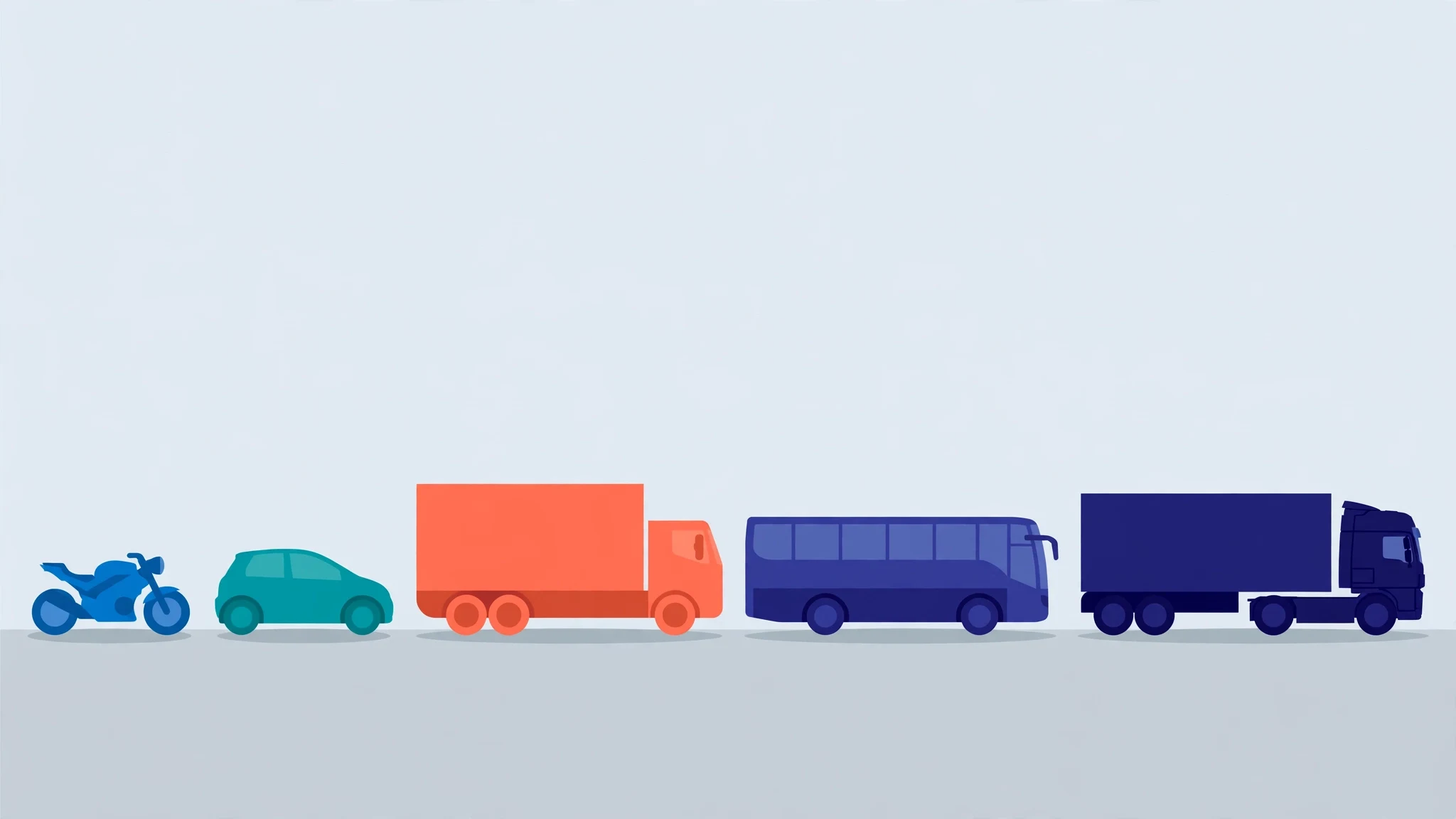
What each letter lets you drive, the minimum age for it, the trailer letters that extend it, and where the professional CPC qualification sits.
Read article