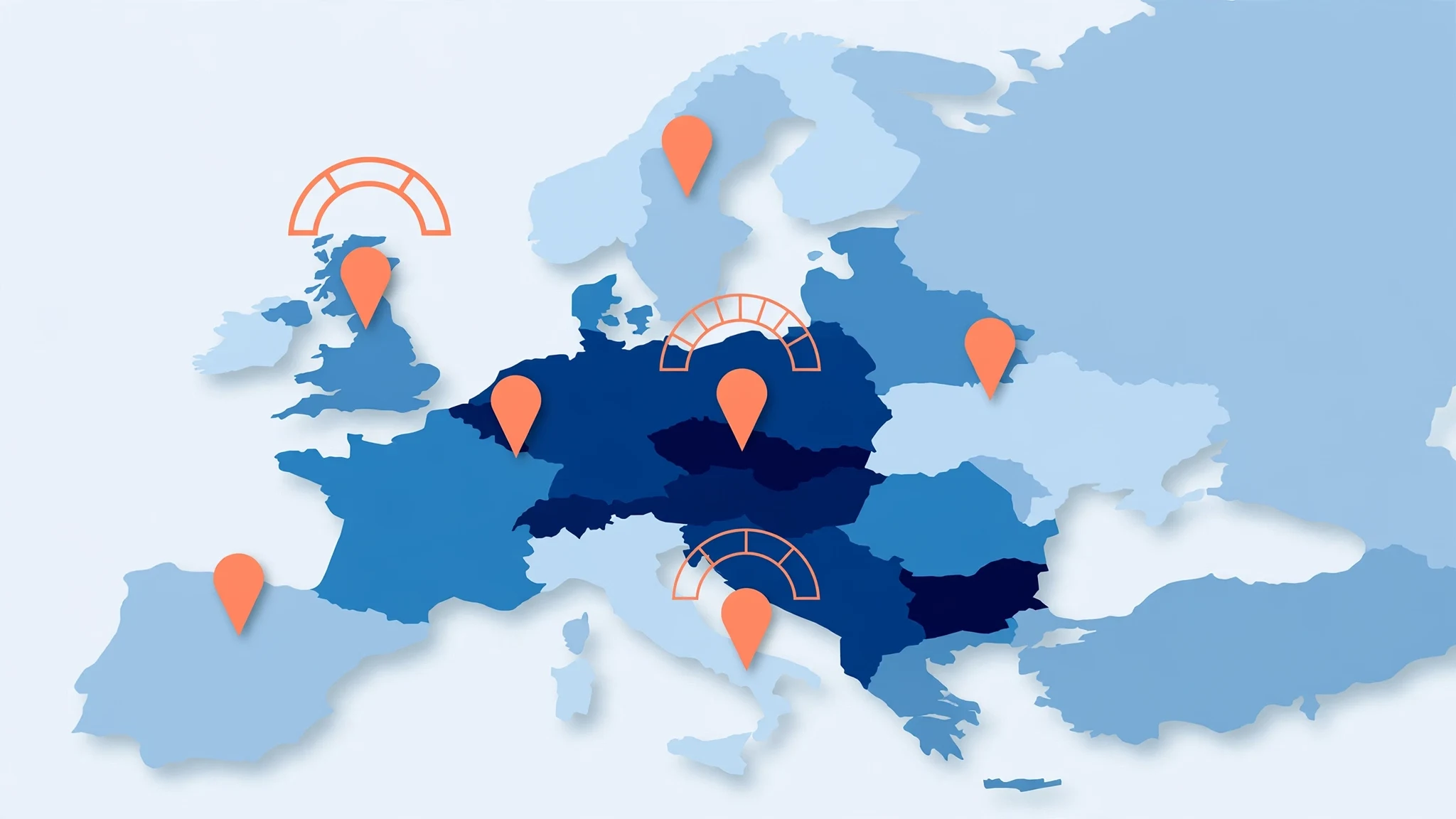
Theory test pass marks across Europe, compared
Seven countries, seven different ways of deciding a pass: correct answers, error limits, error points and weighted points, compared in one table.
Read articleMock tests, road rules and formats follow it.
The letters on a European driving licence look like a code because they are one, but a short one. Category A is motorcycles, B is cars, C is trucks and D is buses, with the same meanings and broadly the same minimum ages from Lisbon to Warsaw. This guide has the driving licence categories explained one by one: what each letter lets you drive, the age it starts at, the trailer categories that extend it, and how the professional CPC qualification, called CAM in Portugal, CQC in Italy and CAP in Spain, sits on top of the licence rather than inside it.
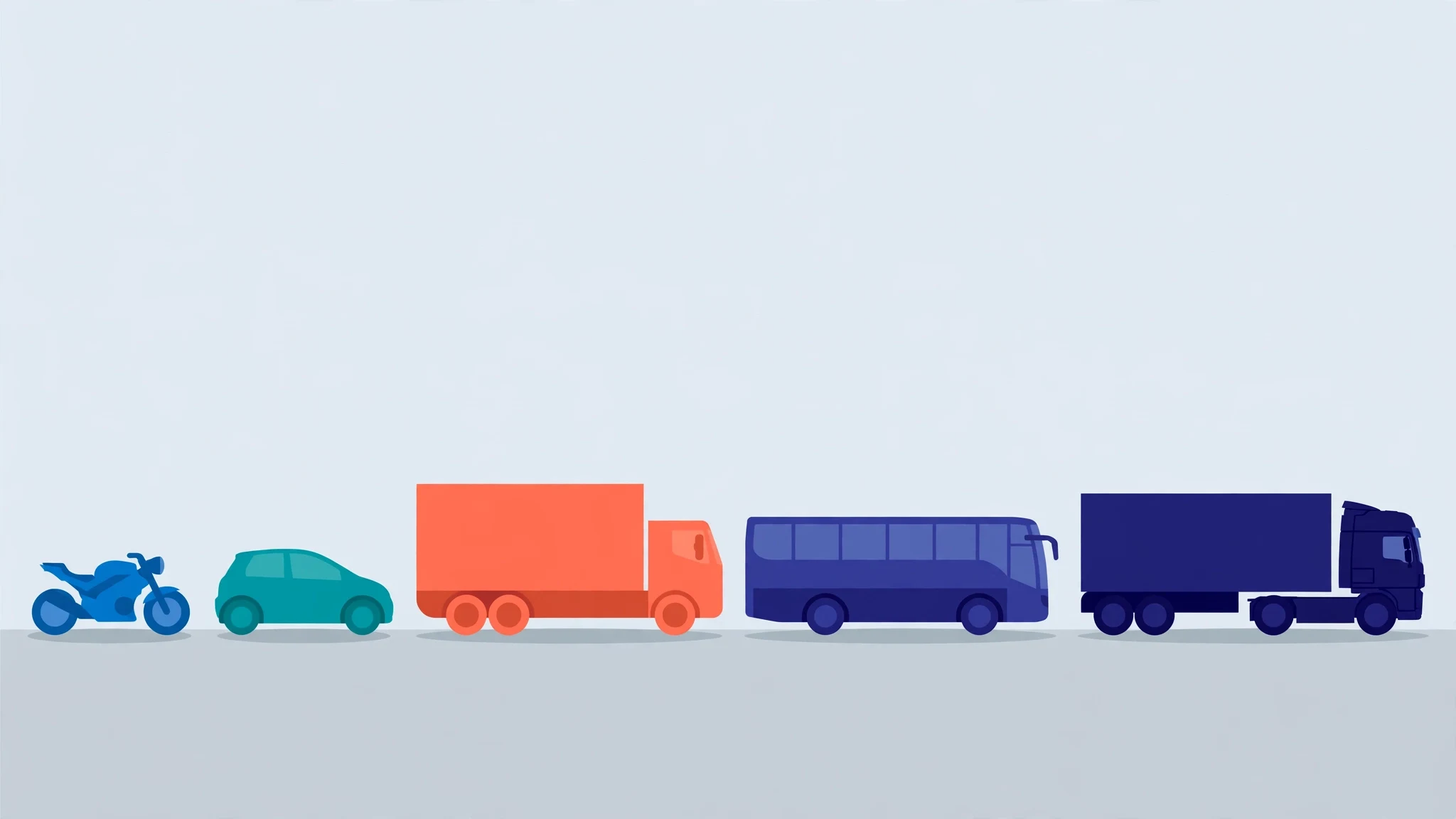
The categories are harmonised across the European Union by the driving licence directive, which defines each category and sets its minimum age. That is why a Portuguese, German or Polish licence uses the same letters, and why a theory test site like this one can organise every country around the same five headings. The summary of the directive published by EUR-Lex is the reference text. Member states keep some freedom to vary ages within limits, and the United Kingdom, no longer in the EU, keeps a closely related system with a few different starting ages, noted where they differ. What follows is the standard framework, the one your exam is built on.
Motorcycles are not one category but a ladder of three, climbed by age and experience. At the bottom, category A1 covers light motorcycles up to 125 cc and 11 kW, from age 16. Category A2 covers motorcycles up to 35 kW, from age 18. Full category A covers motorcycles without a power limit. Its minimum age works two ways: 24 for direct access, or 20 if you have already held an A2 licence for two years, a system called progressive access that rewards time on the smaller machine.
The United Kingdom starts the ladder slightly later: A1 from 17 and A2 from 19, with full A at 24 by direct access. There is also a smaller entry below A1, category AM for mopeds, from age 16 across the EU framework. On this site the ladder is one exam family: the Portugal category A page shows the format, 40 questions with 36 to pass, and each country hub carries its own motorcycle test alongside it.
Category B is the licence most people mean when they say driving licence. It covers motor vehicles up to 3,500 kg with no more than eight passenger seats in addition to the driver: ordinary cars, in other words, and most vans. The standard minimum age is 18. The United Kingdom is the exception on this site, issuing category B from 17, which is why British learners sit their theory test a year earlier than their counterparts in France or Spain.
Trailers are where B gets its fine print. A category B licence covers a trailer up to 750 kg, and combinations beyond that within set weight limits; heavier or more complex combinations belong to category BE. For most drivers the practical boundary is simple: a car and a small trailer are B, a large caravan or a heavy trailer outfit is a question to check before you tow, not after. The United Kingdom category B page shows the test that goes with the letter, and every country hub on this site has its own equivalent.
Goods vehicles split by weight. Category C1 covers vehicles between 3,500 kg and 7,500 kg, from age 18: the large van and small lorry band. Category C covers goods vehicles over 3,500 kg without that upper band, the full truck licence, with a standard minimum age of 21. There is an important professional exception: the minimum age for C can drop to 18 for drivers who hold the professional CPC initial qualification, because their training is longer and examined in its own right. Category CE adds a heavy trailer to a C vehicle. The theory commitment grows with the vehicle: Portugal tests category C at 20 questions with 18 to pass, as the Portugal category C page shows.
Passenger vehicles split by seats. Category D1 covers vehicles built to carry no more than 16 passengers in addition to the driver, from age 21: minibuses. Category D covers vehicles carrying more than eight passengers in addition to the driver, the full bus and coach licence, with a standard minimum age of 24, the highest of any category here. As with trucks, the professional route lowers the line: category D can start at 21 for drivers holding the CPC initial qualification. Category DE adds a heavy trailer to a D vehicle. Portugal tests category D at 20 questions with 18 to pass, the same shape as C, as the Portugal category D page sets out.
CPC is not a vehicle category and it does not appear on the licence as a letter of its own. The Driver CPC, Certificate of Professional Competence, is a qualification that professional truck and bus drivers hold alongside their C or D licence, evidenced by code 95 entered on the licence. It has two parts: an initial qualification taken when a driver first goes professional, and periodic training of 35 hours every five years that keeps it valid. The framework is European, but the names are national. In Portugal it is the CAM, tested at 60 questions with 36 to pass on the Portugal CAM page. In Italy it is the CQC, in Spain the CAP, in France it sits within the FIMO and FCO training system, and in the United Kingdom it is Driver CPC. When a job advert asks for C plus CPC, it is asking for the letter and the qualification together.
| Category | Vehicles | Standard minimum age |
|---|---|---|
| AM | Mopeds | 16 |
| A1 | Motorcycles up to 125 cc and 11 kW | 16 (17 in the UK) |
| A2 | Motorcycles up to 35 kW | 18 (19 in the UK) |
| A | Motorcycles without power limit | 24, or 20 with two years on A2 |
| B | Cars and vans up to 3,500 kg, up to 8 passenger seats | 18 (17 in the UK) |
| C1 | Goods vehicles 3,500 to 7,500 kg | 18 |
| C | Goods vehicles over 3,500 kg | 21, or 18 with CPC initial qualification |
| D1 | Up to 16 passengers plus the driver | 21 |
| D | More than 8 passengers plus the driver | 24, or 21 with CPC initial qualification |
Ages are the standard minima from the EU framework and the corresponding UK rules. Individual countries may vary some ages within the limits the directive allows, and accompanied driving schemes can let learners start practical driving earlier without changing the age of the full licence, so always confirm the current position with your own licensing authority before you book training. United Kingdom readers will find the UK test structure that sits behind these categories on GOV.UK.
Work backwards from the vehicle and the job. Riding for yourself means the A ladder, choosing your rung by age and the machine you actually want to ride. Driving a car or a van for private use is B, and B is also the base licence the professional categories build on: you cannot reach C or D without passing through the car licence first in the normal sequence. Working as a driver means deciding between goods and passengers early, because C and D lead to different employers, different specialist exam sections and the same CPC layer on top. Whatever you choose, the theory test comes first in every country, and the formats differ by category as much as by country: our comparison of theory test pass marks across Europe shows the numbers per system, and the two week study plan turns whichever format you face into a schedule. If a first attempt at any of these categories goes wrong, the retake rules by country explain how each system lets you come back.
Seven countries, seven different ways of deciding a pass: correct answers, error limits, error points and weighted points, compared in one table.
Read article
Fourteen days, split into topic learning, timed mock tests and a mistakes review, planned around the exact pass mark of the exam you are taking.
Read article
How soon you can sit again, what you have to retake, and how rebooking works, for the UK, Germany, Italy, Spain, France, Portugal and Poland.
Read article