
How to prepare for your theory test: a two-week study plan
Fourteen days, split into topic learning, timed mock tests and a mistakes review, planned around the exact pass mark of the exam you are taking.
Read articleMock tests, road rules and formats follow it.
A developing hazard is the part of the United Kingdom theory test that is scored on timing instead of knowledge. You watch video clips from the driver seat and respond at the moment a hazard starts to develop. Respond inside the scoring window and you earn up to 5 points; respond too early, too late or in a pattern and you earn none. This article explains what counts as a developing hazard, how the window works, and how to train your eye to catch hazards while they are still forming.
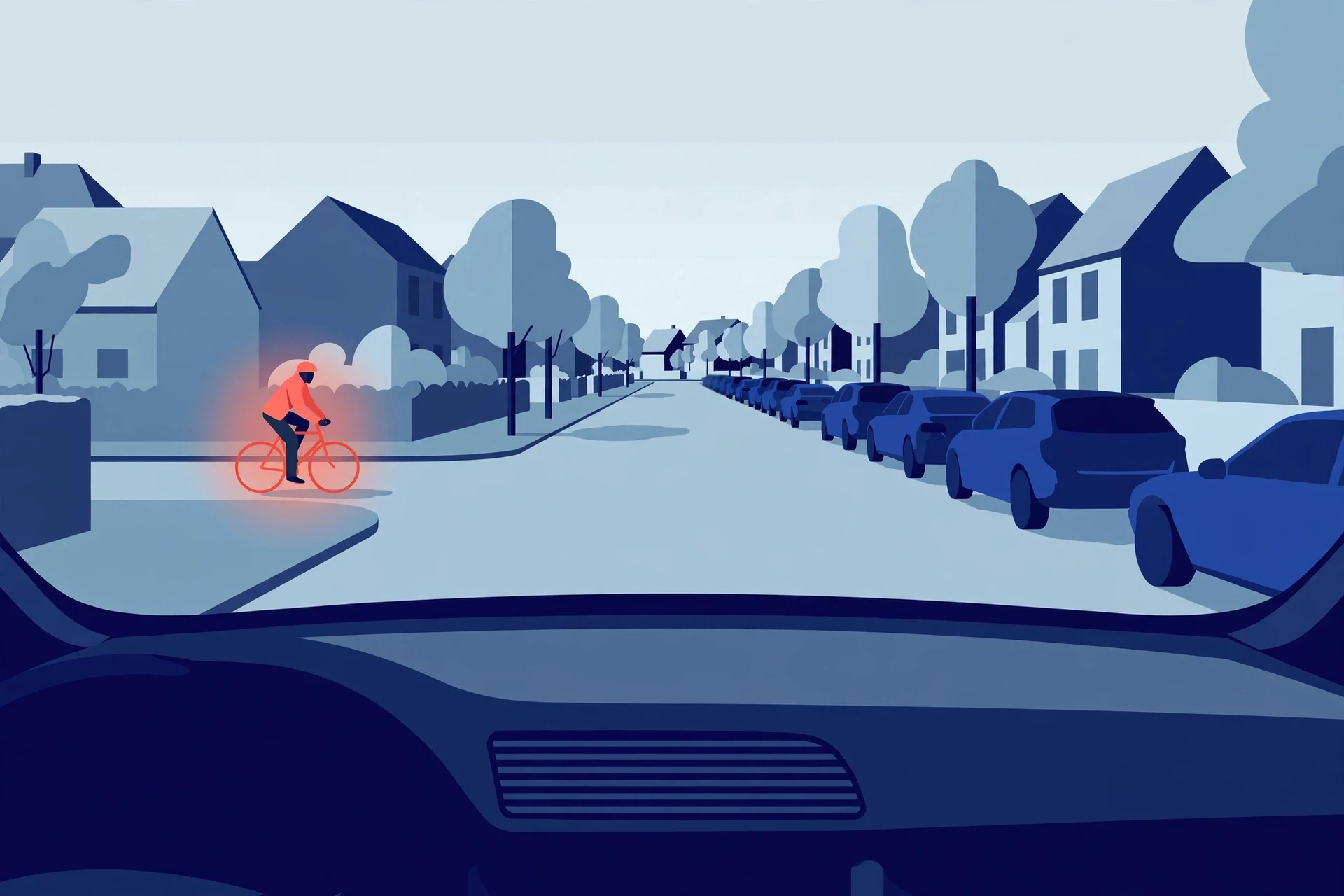
The Driver and Vehicle Standards Agency definition, put plainly, is this: a developing hazard is something that would make you change speed or direction. That short test, would I have to slow down or steer because of this, is the whole skill. A parked car on the side of the road is not, by itself, a developing hazard, because it asks nothing of you. The same parked car becomes one the moment its door opens into your path, its indicator comes on, or it begins to pull out. Nothing about the object changed. What changed is what it is about to make you do.
This is why hazard perception explained properly is really a lesson in reading movement and intention. The exam is not asking whether you can see objects. It is asking whether you can spot the moment a situation stops being background and starts becoming your problem, and it pays the highest score for the earliest correct reading of that moment.
Examiners and instructors often split hazards into two stages. A potential hazard is anything that could become a problem: a pedestrian standing at the kerb, a car waiting at a side road, a cyclist riding ahead of you, a bus stopped at a bus stop. A developing hazard is the same scene one beat later, when the possibility turns into a course of action: the pedestrian steps off the kerb, the waiting car rolls forward, the cyclist looks over a shoulder and drifts toward the middle of the lane, the bus indicates and begins to move off.
The scoring window opens at the developing stage, not the potential stage. Click when you first notice the pedestrian standing still at the kerb and you may be too early, before the window, scoring nothing for that hazard. Wait until the pedestrian is halfway across the road and the window has nearly closed, leaving you 1 point or none. The candidates who score well are not the ones who click most. They are the ones who have learned to tell the two stages apart, and to respond in the first moments of the second stage.
The hazard perception part of the UK theory test for car drivers shows 14 video clips filmed from the driver seat. Across those clips there are 15 scored developing hazards, because one clip contains two. Each hazard carries a scoring window that is divided into five zones. Respond in the first zone, just as the hazard begins to develop, and you score 5 points. Each later zone is worth one point less, down to 1 point near the end of the window. Respond before the window opens or after it closes and that hazard scores zero. The maximum is 75 points and the pass mark is 44.
Two scoring rules catch people out. The first is that there is no second chance inside a clip: once the window for a hazard has passed, later clicks on the same hazard add nothing, so the skill is anticipation, not reaction speed. The second is the pattern rule. The software watches how you respond across a clip, and clicking repeatedly, rhythmically or in a pattern scores zero for that clip even if some of your clicks landed inside a window. The official guidance on pass marks and results is published by GOV.UK, and the same 43 of 50 and 44 of 75 figures apply to the car test. You can rehearse the exact mechanic in our hazard perception practice section, which uses practice clips, windows estimated by us, and the same 5 down to 1 scoring with the pattern rule applied.
You are driving along a residential street lined with parked vehicles. Between two of them, you glimpse a pedestrian walking toward the road, still on the pavement, partly hidden. At this stage it is a potential hazard: worth watching, not yet worth a response. The hazard develops when the pedestrian keeps moving into the gap and steps toward the carriageway without looking your way. That is the moment to respond, while the pedestrian is committing to crossing, not once they are directly ahead of your bonnet.
A car waits at a junction on your left. Waiting is potential. The hazard develops when the car begins to creep forward past the give way line, or its wheels turn toward your lane while its driver looks the other way. Respond as the car starts to move into your path. If you wait until it is fully out and you are already braking in real life, the clip has taken most of the points away.
A cyclist rides ahead of you with a row of parked cars beyond them. The developing moment comes when the cyclist glances back, signals or starts to move out to pass the parked cars, because that line change brings the cyclist into the space you are about to occupy. This example teaches the general pattern: hazards often develop because of what is in front of the other road user, not because of the road user alone.
On a motorway or dual carriageway, the vehicle ahead brakes, then the one ahead of it, and the traffic stream compresses toward you. A single set of brake lights far ahead is information. The hazard develops when the slowing becomes a wave travelling back to your lane, or when a vehicle ahead begins a lane change into your gap to escape it. Respond when the slowdown starts to involve your lane, which is earlier than the moment your own braking would begin.
On a rural road you pass a field entrance with a tractor waiting, its front wheels already angled toward the road. Rural hazards develop slowly and then occupy a lot of space. The window opens as the tractor begins to roll out, because a long vehicle crossing your lane leaves you fewer options than a car would. The same early reading applies to horse riders moving toward the road edge and to animals near a gap in a hedge: the commitment to move is the signal, not the completed movement.
Three habits account for most lost marks. The first is responding to everything: clicking for every parked car and every pedestrian in sight. That produces early clicks before windows open and risks the pattern rule. The second is waiting for certainty. If you only respond once you are sure, you have usually waited through the 5 and 4 point zones; the test rewards a well judged early response to a hazard that is genuinely developing. The third is treating each clip as one hazard. One clip carries two scored hazards, and candidates who relax after the first response regularly miss the second entirely.
The scanning habit transfers from real roads, and you can build it as a passenger or a driver without any software. Look as far ahead as the road allows rather than at the car in front. Sweep side roads, gaps in hedges, bus stops and parked rows as you approach them, and ask the developing question about anything you see: is it moving, is it about to move, and if it moves, does it make me change speed or direction? Road safety bodies such as RoSPA publish guidance on observation and anticipation that supports exactly this kind of scanning, and it is worth reading alongside clip practice.
Combine that with structured preparation for the multiple choice half. You must pass both parts in the same sitting, 43 of 50 on the questions and 44 of 75 on the clips, and a strong score in one cannot rescue a fail in the other. The United Kingdom hub collects both halves, the mock test rehearses the questions under time pressure, and our two week study plan shows where hazard practice fits into a full schedule. If clips are your weak half, compare your situation with the other formats in theory test pass marks across Europe: the United Kingdom is the only country on this site where spotting danger on video is a pass or fail condition of its own.
Fourteen days, split into topic learning, timed mock tests and a mistakes review, planned around the exact pass mark of the exam you are taking.
Read article
Seven countries, seven different ways of deciding a pass: correct answers, error limits, error points and weighted points, compared in one table.
Read article
How soon you can sit again, what you have to retake, and how rebooking works, for the UK, Germany, Italy, Spain, France, Portugal and Poland.
Read article